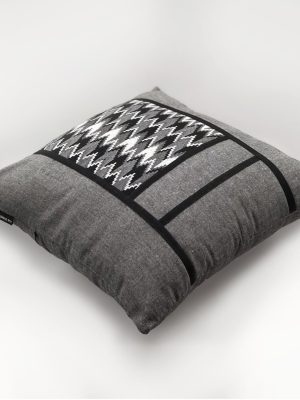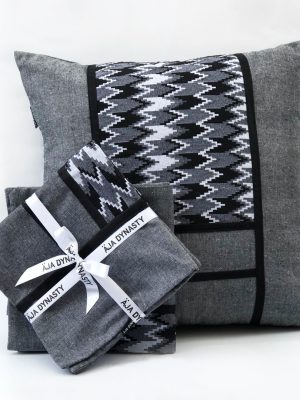
Tharu Art and Ornaments: The Culture Behind Our Tharu 4 Cushion Cover

Most people who visit Nepal’s Terai region think of it as a transit zone — a flat stretch you pass through on the way to the hills. What they miss is one of Nepal’s oldest livings Tharu art and ornaments as well as cultures, right there under the open sky.

The Tharu people are the indigenous community of the Terai. They’ve been there for over a thousand years. Scholar Al-Biruni documented their presence in eastern Terai as far back as the 10th century. And in that long stretch of time, they built something genuinely distinct — in their art, in the ornaments they wear, and in the way they mark their own bodies.

This blog is about that culture. And about why it matters enough that Aja Dynasty built a cushion cover collection around it.
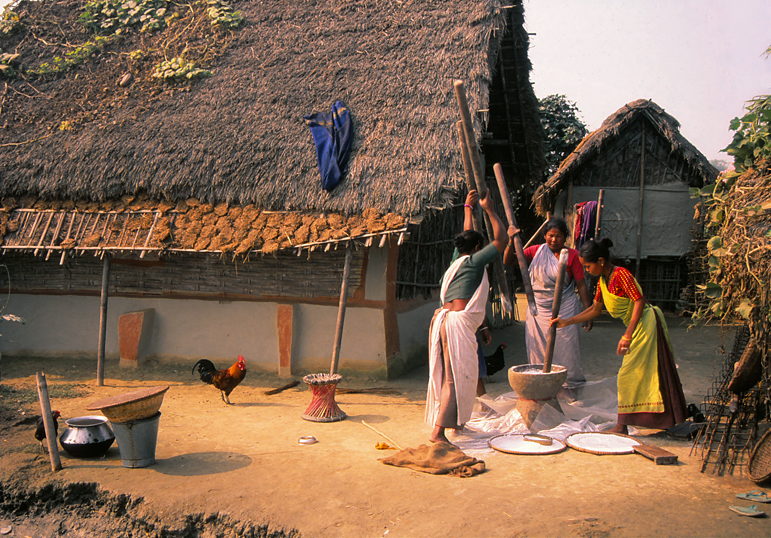
tharu art and ornaments
Tharu Women Traditionally Working Together

Who Are the Tharu People?

The Tharu are not one uniform group. They’re spread across the entire Terai belt — from Kanchanpur in the far west all the way to Morang and Sunsari in the east. Each region has its own subgroup: Rana Tharu and Kathariya Tharu in Kailali and Kanchanpur, Dangaura Tharu across western Terai districts like Dang, Bardia, and Rupandehi, Chitwan Tharu in the central belt, and Kochila and Danuwar Tharu in the east. Beyond Nepal, Tharu communities also live in adjacent parts of northern India.

Their origin stories are just as varied. Rana Tharus in western Nepal trace their roots to the Thar Desert of Rajasthan and consider themselves descendants of the Rajput family. Others claim descent from Gautama Buddha himself. What unites all these subgroups is something harder to pin down — a way of being in the world that shows up most clearly in their art, dress, and daily rituals.

Tharu Art and Ornaments: What It Looks Like and Why
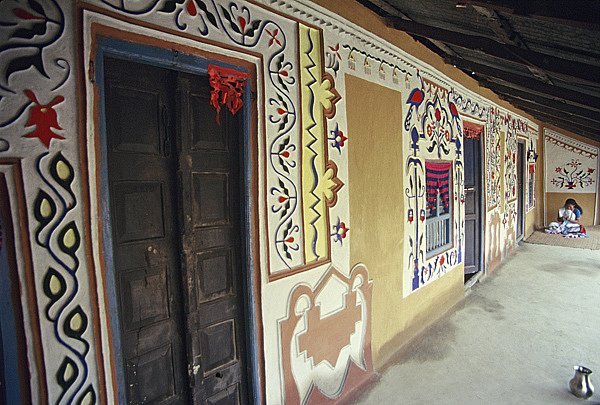
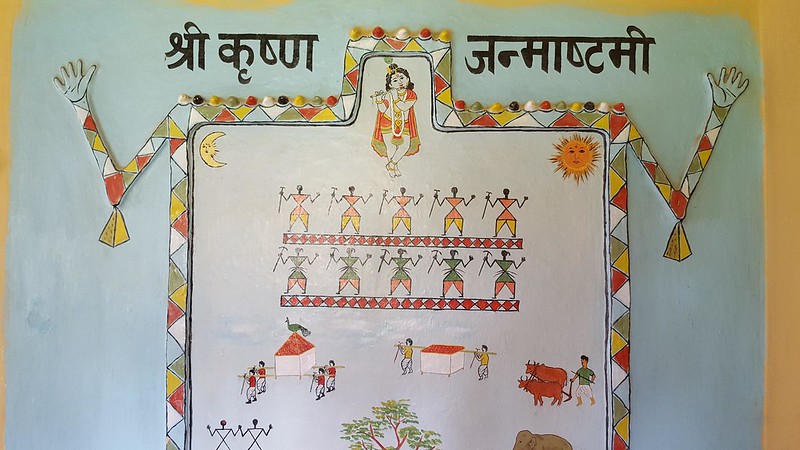
Art made by Tharu People on the wall of their home

Art made by Tharu People on the occasion of Lord Krishna’s Birthday.

Walk into a traditional Tharu home and the walls tell you everything. Elephants, lions, horses, peacocks, fish, snakes, and flowering plants — painted directly onto the mud walls in a technique that resembles fresco painting. These aren’t decorations chosen for aesthetics. Each motif is tied to nature, belief, or community life.

Tharu women paint these walls themselves. They also decorate everyday household objects — Dhakiya, Machiya, Chhatari, Delawa, Moka, and others — turning functional items into something you’d stop to look at. On festivals like Astamika, Amausa, and Diwali, the paintings shift to include deities: Bhairava, Krishna, Rama, the Pandavas and Kauravas, and Astamatrika.

Beyond wall painting, Tharu arts include woodcarving and terracotta work. The Kuhara clan has a reputation for terracotta and pottery figurines. Tharu woodcarvers shape statues of Ganesha, Mahadeva, Brahma, and Vishnu, and carve their doors, windows, and household tools from the Saal tree.

What makes Tharu art distinct from other Nepali folk traditions is its closeness to the natural world. There are no abstract decorative fillers. Every elephant, every snake, every flower is there because it belongs.

Tharu Ornaments: A Head-to-Toe Tradition
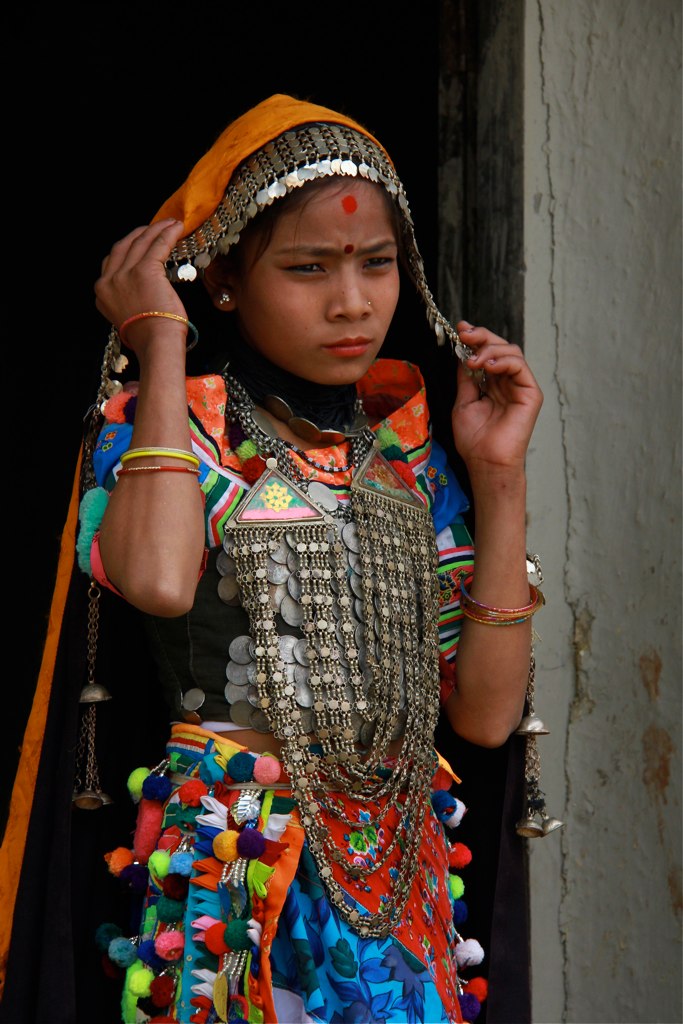
Tharu girl beautifully dressed in her cultural attire and ornaments.

When people talk about Tharu dress and ornaments, they usually mean the women — because the tradition of Tharu ornaments is most fully expressed by Tharu women, from head to foot, and every part of the body has its own vocabulary of jewelry.

On the forehead and head: Kilipha, Kanta, Phulara Choti, Maniya, Senura, Tikuli, Dhari, and Tikka.

On the nose: Phophi, Phuliya, Nathiya, Nathuni, Nasaa, and Khila — worn specifically on the left side of the nose.
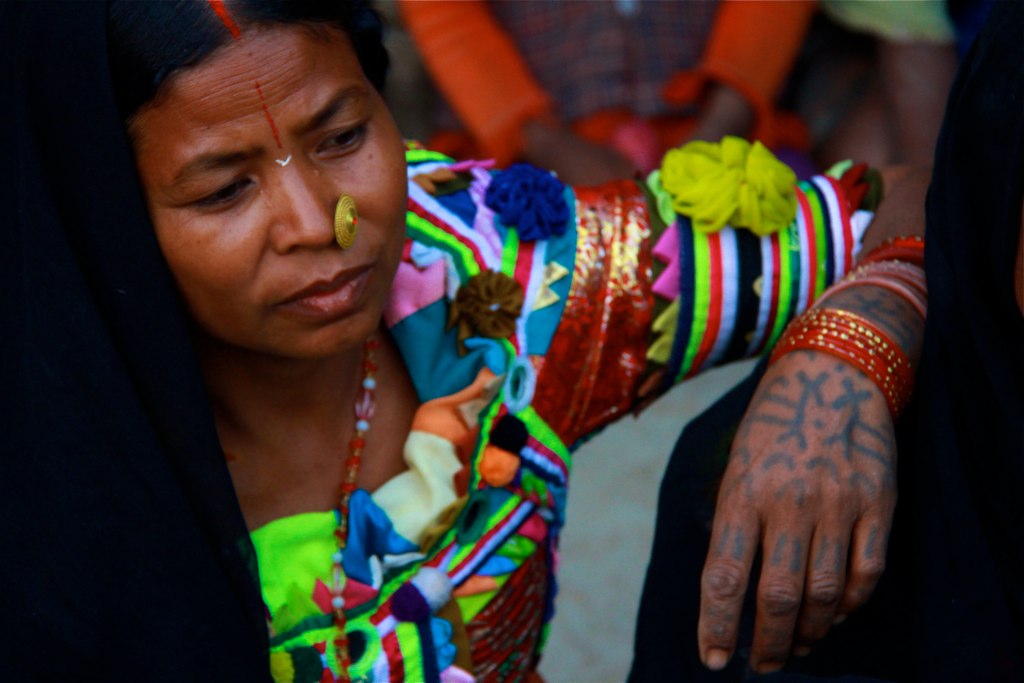
Tharu woman wearing Phuli on her nose.

On the ears: Taraki, Sikadi, Sidhari, Lari, Tappa, Jhumka, Laheka, Tarki, Aerana, and Bichakani.

On the neck: Sutiya, Thumari, Rupayakamala, Chaukimala, Hara, Sitahara, Chandrahara, Sikadi, and Mudiyamala.
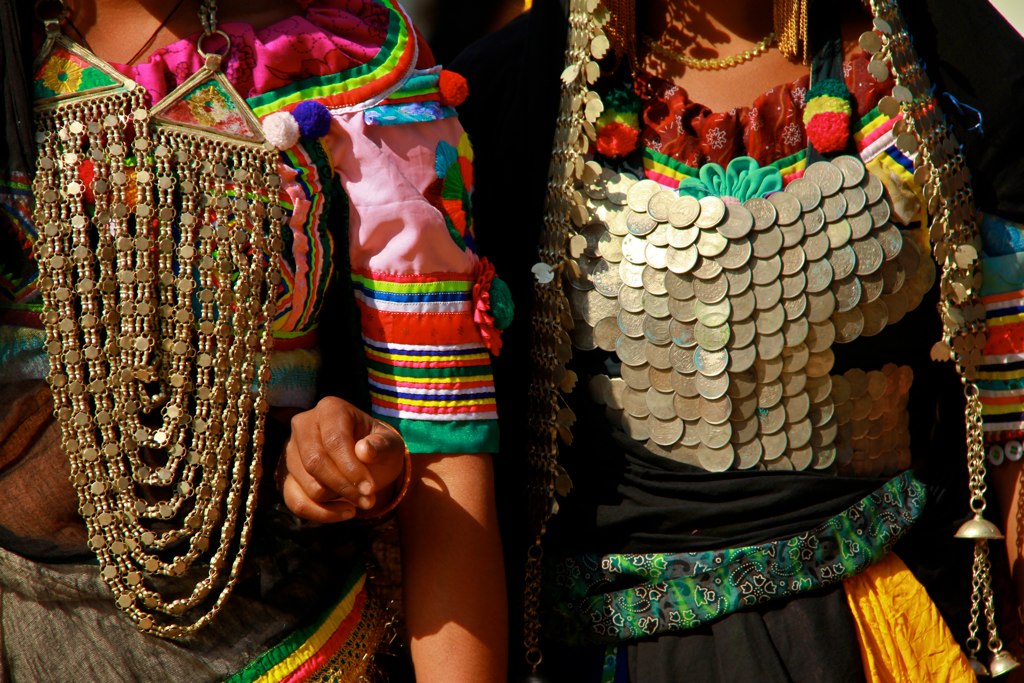
Different Tharu neck ornaments.

On the hands and arms: Baju, Churiya, Bahotta, Kanna, Tediya, Lahathi, Josana, Pahunchi, Agela, Pacchela, Chhaniya, Rupayaka, Bahulla, and Saloni.

That’s not a list padded for length. Each name is a real, distinct ornament with its own place and meaning. Tharu ornaments are not mixed and matched randomly — there’s a grammar to how they’re worn, one that Tharu women learn over time.

This tradition of Tharu dress and ornaments is one of the most detailed in Nepal’s Terai communities. And like most traditions, it’s changing. Younger women wear fewer pieces. Some items are now found only in museums or on older women during festivals.

Tharu Tattoo: The Ink That Goes with You
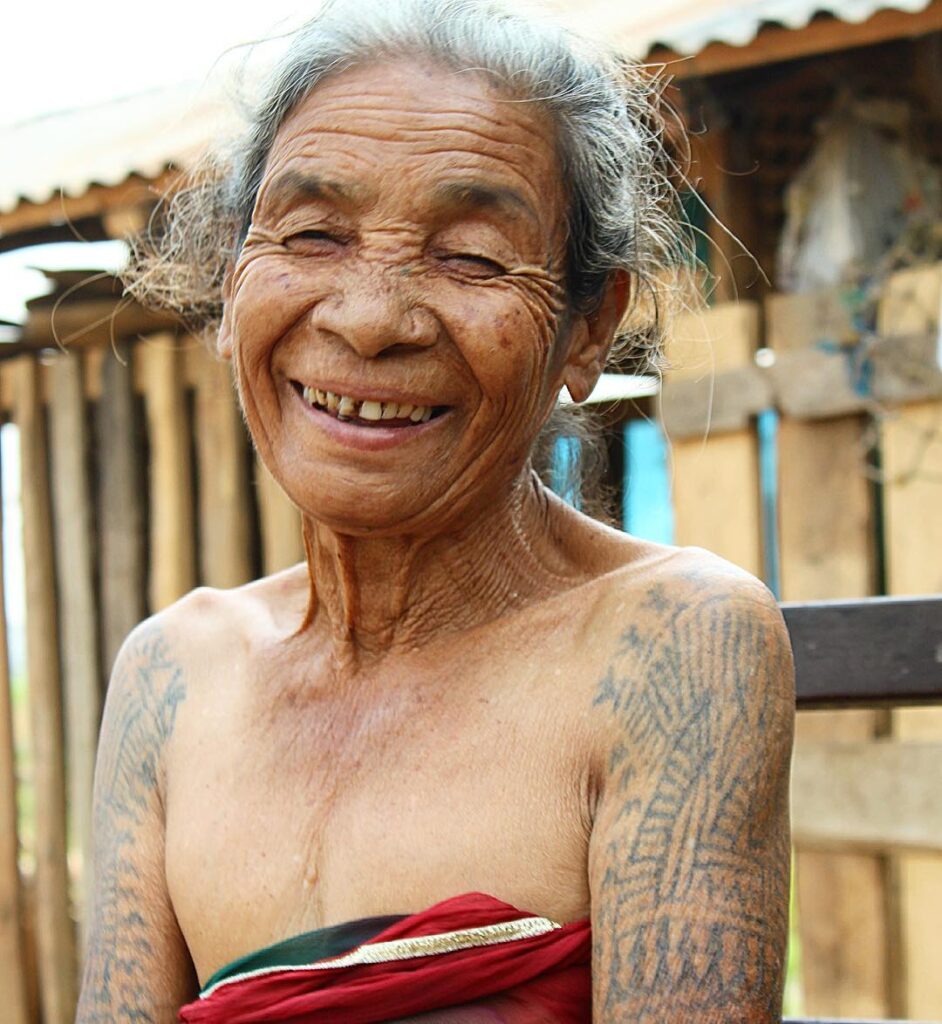
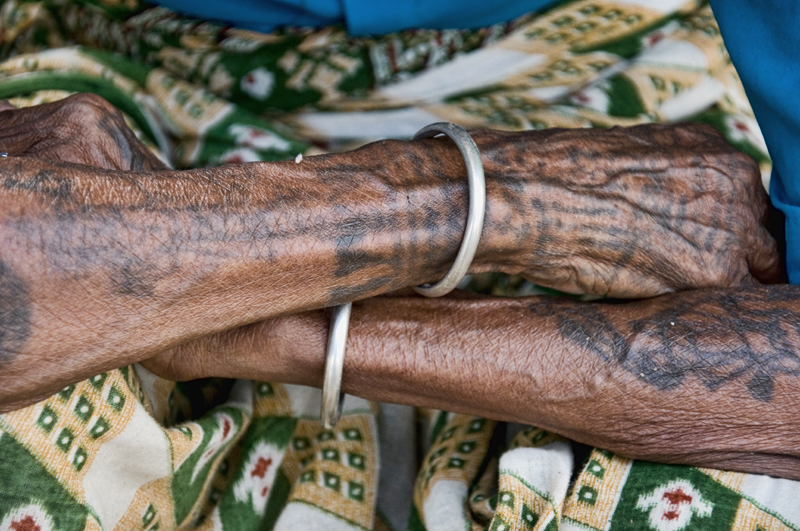
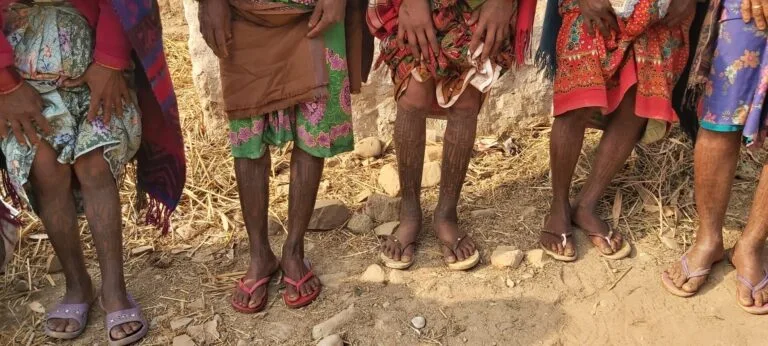
Tharu old women showing her tattoos.

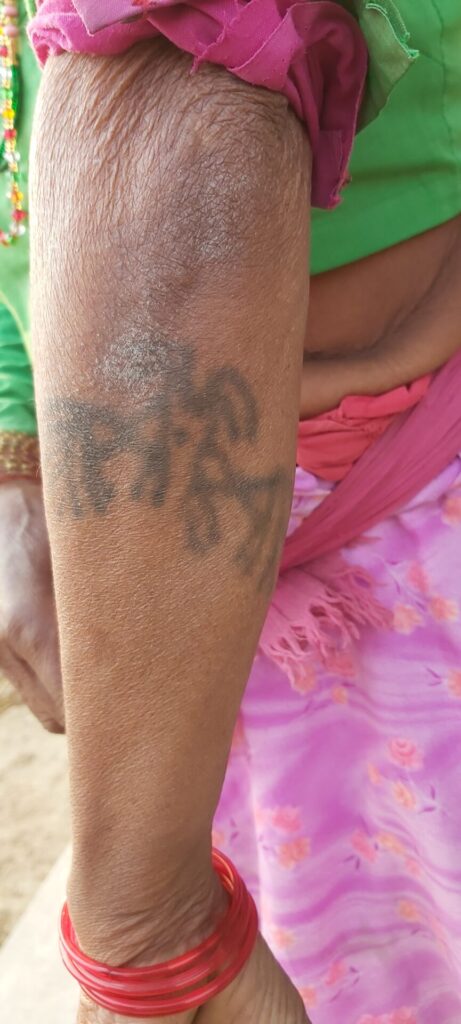
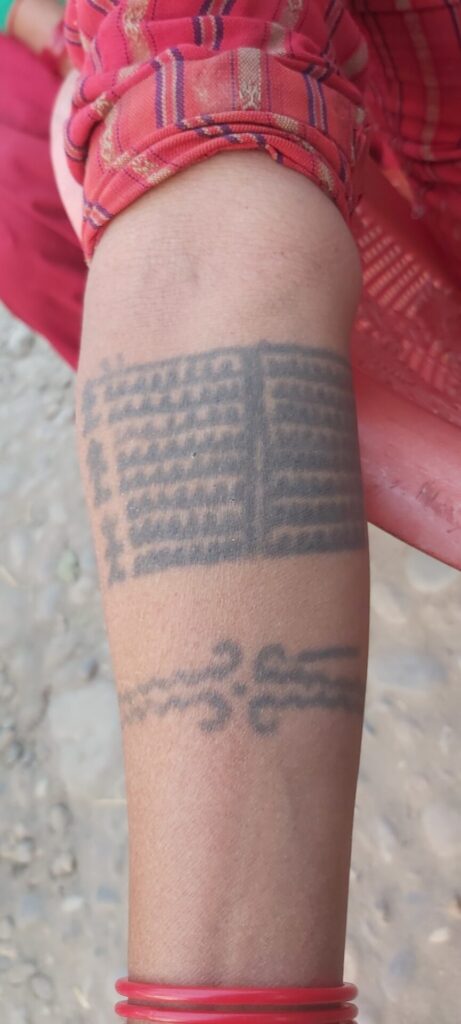
Tharu tattoo on woman’s hand.

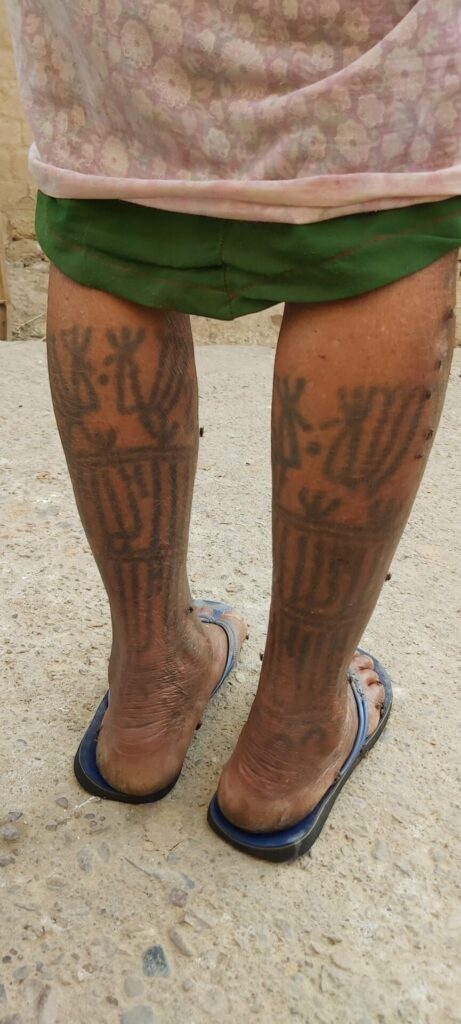
The Tharu tradition of tattooing is called “Khodna” or “Godana.” Women get tattooed on their hands, thighs, legs, chest, and backs. The tattoos are done by women tattooists called “Tikaniya” using sharp needles and black ink made from the soot of a mustard lamp. It’s painful enough that people sometimes faint during the process.

The designs come from nature — peacocks, a bird called Mejoor, lines, dots, crosses, and other elements from the world around them. Simple on the surface, but specific. Not decorative filler.

The beliefs behind Tharu tattoos are serious ones:

Tharu women believe the tattoos go with them to the next dimension after death. They’re considered personal property and gifts to the deceased. They also treat them as permanent jewelry — ornaments that can never be stolen, that stay on the body for life.

In earlier generations, Godana was something every married Tharu woman had. Today, among younger women, the practice is fading. You’ll mostly see these tattoos now on older women. Modernization didn’t preserve it, and that’s a real loss — not a polite cultural observation, but an actual disappearance of something that took centuries to develop.

The Tharu Cushion Cover: Bringing It Home

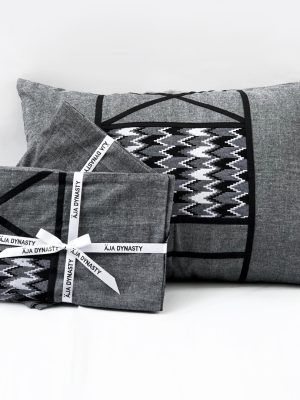
The Aja Dynasty Tharu cushion cover collection draws directly from Tharu tattoo art. The motifs on each cover are the same ones Tharu women carried on their skin — peacocks, Mejoor birds, geometric patterns from nature — translated onto fabric for your home.

It’s a small thing, but it’s intentional. When a tradition stops being practiced, the only way to keep it alive is to keep it visible. These cushion covers do that without turning the culture into a costume.

The collection comes in:

  • 2 sizes to fit standard and larger cushions
  • 4 designs — Tharu Cushion Cover 1, 2, 3, and 4 — each based on distinct tattoo motifs

For photos and full details of each design, visit the Aja Dynasty Shop section.

FAQs

What is Tharu art?

Tharu art is the visual tradition of Nepal’s indigenous Tharu community, primarily from the Terai region. It includes wall paintings, woodcarving, pottery, and tattooing — all deeply tied to nature. Common motifs include elephants, peacocks, fish, snakes, and flowering plants.

What are Tharu ornaments?

Tharu ornaments are a layered system of jewelry worn by Tharu women across the head, nose, ears, neck, and hands. Each piece has a specific name and place. Examples include Tikuli on the forehead, Nathiya on the nose, Jhumka on the ears, and Churiya on the wrists.

What is Tharu tattoo called?

The traditional Tharu tattoo is called “Khodna” or “Godana.” It’s applied by women tattooists called Tikaniya, using needles and ink made from mustard lamp soot. Designs come from nature — birds, geometric patterns, plants.

What inspired the Tharu cushion cover designs?

The Aja Dynasty Tharu cushion covers are based on traditional Tharu tattoo motifs. The same designs that Tharu women wore on their bodies — peacocks, the Mejoor bird, geometric patterns — appear on the cushion covers.

Where do the Tharu people live?

Tharu people live across Nepal’s Terai belt and in parts of northern India adjacent to Nepal. Major subgroups include Rana Tharu and Kathariya Tharu in Kailali and Kanchanpur, Dangaura Tharu in western Terai, Chitwan Tharu in central Nepal, and Kochila and Danuwar Tharu in eastern Terai.

How many designs does the Tharu cushion cover come in?

The Aja Dynasty Tharu cushion cover comes in 4 designs (Tharu Cushion Cover 1, 2, 3, and 4) and 2 sizes. Full photos and details are available in the Aja Dynasty Shop.

Related reading: Aja Dynasty Cushion Cover Collection || Tharu : And Ancient Tattoo Artist

Source: Tharu community documentation; Aja Dynasty product research; Al-Biruni historical records on Tharu presence in eastern Terai
Tharu Cushion Cover: The Ancient Tattoo Art That Almost Disappeared

Have you ever argued with your parents to get one small tattoo? Most of us have been there. But in one community in Nepal, that argument never happened — because tattoos weren’t rebellion. They were tradition.

The Tharu ethnic community of Nepal has practiced tattooing for generations. And here’s the part that surprises most people: it was the women, not the men, who carried this tradition on their skin.

What Is Tharu Tattoo Culture?

In the Tharu community, tattooing goes by the name “Khodna” or “Godna.” These are not decorative tattoos picked off a studio wall. Every design comes from the natural world around them — rays of the sun, peacocks, peanut plants, snakes. Some women also wore symbols like temples, cooking pots, hearts, or the names of gods on their bodies.

The designs were personal. Earned. Tied to belief.

Tattoo on the hand of Tharu woman

Why Did Tharu Women Get Tattooed?

There were several reasons, and none of them were about trends.

Spiritual protection. Tharu women believed that being tattooed secured a place in heaven. Without tattoo marks, you risked ending up in the other place entirely. So for many, it wasn’t optional — it was insurance.

Healing. When someone had pain in a part of the body, a tattoo was applied to that spot. The belief: the act of tattooing opened a path for the pain to leave. No doctor, no medicine — just ink and faith.

Newborn rituals. Even babies weren’t spared. Infants were tattooed on their legs, hands, or chest as part of Hindu-influenced rituals, following the same spiritual beliefs that adults held.

Fertility. A married woman who couldn’t conceive was advised to get a tattoo on her chest. Whether this worked is another matter, but the belief was real and widely followed.

Permanent jewelry. For Tharu women, tattoos were not separate from beauty — they were beauty. Permanent jewelry, worn on the body rather than hung around the neck. Before young Tharu girls were married, getting tattooed was considered both normal and necessary.

The Dark History Behind the Ink

This part of the story is harder to hear.

Tharu women also used tattoos to protect themselves from being taken as sex slaves by royal and powerful men. Tattooed skin was considered unappealing to those men, which made the ink a form of armor. That women had to mark their own bodies to avoid exploitation says something deeply uncomfortable about the time — and the power structures that existed.

The tattoo was never just decoration. It was survival.


Tattoo on the leg of Tharu woman.
Tattoo on the hand of Tharu woman.

A Culture That’s Disappearing

Today, you’ll only find these traditional tattoo marks on the bodies of older Tharu women. Younger generations have largely moved away from the practice. Modernization brought change, and this particular tradition didn’t survive the transition.

That’s not a small loss. These were not random designs. They were stories — of belief, of protection, of identity — carried on skin for a lifetime.

How the Tharu Cushion Cover Keeps It Alive

Aja Dynasty created the Tharu cushion cover as one small way to keep this tradition visible.

The designs on these cushion covers are drawn directly from Tharu tattoo patterns — the same motifs that Tharu women wore on their bodies for generations. Buying one doesn’t just add something to your sofa. It connects your home to a story that might otherwise disappear entirely.

The Tharu cushion cover comes in:

  • 2 sizes to fit different cushions
  • 4 designs — Tharu Cushion Cover 1, 2, 3, and 4 — each featuring distinct Tharu tattoo motifs

These also work well as outdoor cushion covers, since the fabric holds up across different settings.

For photos and full size details of each design, visit the Aja Dynasty Shop section.

FAQs

What is a Tharu cushion cover?

A Tharu cushion cover is a decorative cushion cover inspired by the traditional tattoo art (“Khodna” or “Godna”) of the Tharu ethnic community in Nepal. Aja Dynasty produces these covers in 4 designs and 2 sizes.

What designs are on the Tharu cushion covers?

The patterns come from traditional Tharu tattoo motifs — including images of peacocks, the sun, snakes, and peanut plants — the same symbols Tharu women traditionally wore as tattoos on their bodies.

Can Tharu cushion covers be used outdoors?

Yes. They work as outdoor cushion covers, though we recommend checking the specific care instructions for each design in the shop.

Where can I buy Aja Dynasty’s Tharu cushion covers?

You can find all 4 designs and both size options in the Aja Dynasty Shop section on their website.

Why is Tharu tattoo culture important to preserve?

Tharu tattooing is a centuries-old practice tied to spirituality, healing, and identity. As modernization has reduced the practice among younger generations, objects like the Tharu cushion cover help document and carry these designs forward.

Related: Tharu Culture and Heritage · Handmade Cushion Covers from Nepal

Sources: Aja Dynasty, field documentation of Tharu tattoo practices in the Terai region of Nepal

National Food of Nepal: Dal Bhat — The Dish That Powers a Nation

Table of Contents

What Is the National Food of Nepal?

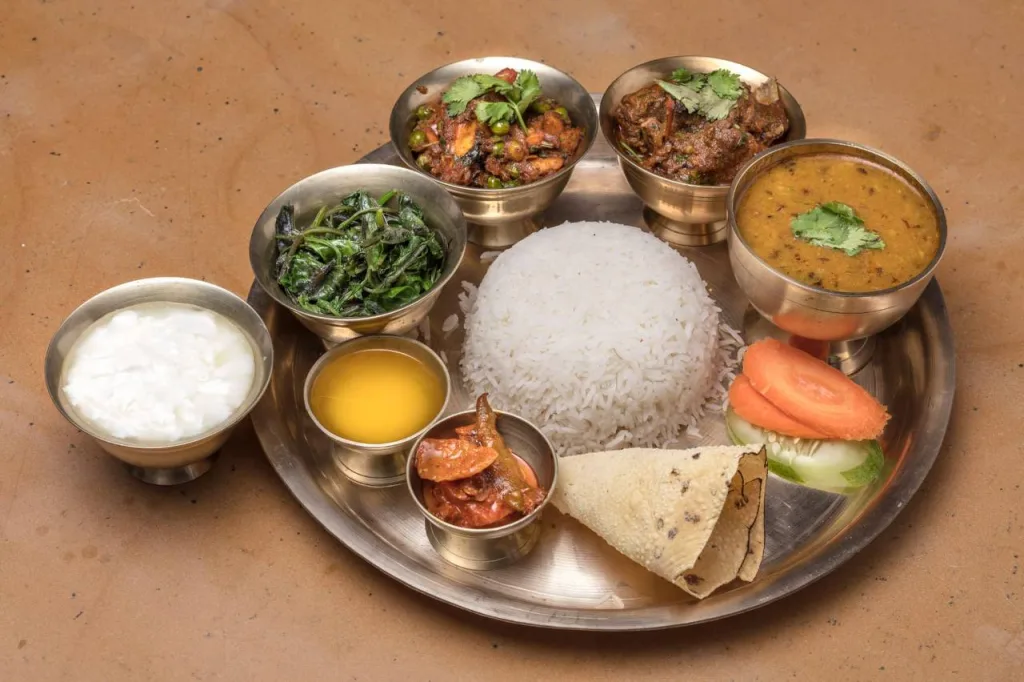
The national food of Nepal is Dal Bhat — a wholesome combination of steamed white rice (bhat) served alongside a warm, spiced lentil soup (dal). Despite Nepal’s remarkable diversity in topography, culture, and religion, Dal Bhat is the one thing that unites virtually every Nepali household, from the Himalayan highlands to the Terai plains.

Lentil soup is enjoyed across the Middle East and the Indian subcontinent, but the distinctive dal bhat food tradition — the specific combination, preparation style, and cultural centrality — originated in Nepal and has been passed down through generations. Over time, this culinary tradition has spread to parts of India and Bangladesh as well.

As the national dish of Nepal, Dal Bhat is far more than a meal. It is identity, sustenance, and daily ritual all in one bowl.

Why Dal Bhat Is More Than Just Food

Nepali people have a beloved saying: “Dal Bhat power, chaubis ghanta” — meaning Dal Bhat gives you energy for twenty-four hours. This poetic belief has resonated so strongly that it is now famous among international trekkers and visitors to Nepal. Ask any porter or guide on the Annapurna or Everest trails, and they will tell you the same thing: Nepali food dal bhat is the engine that keeps them going.

For most Nepali people, dal and bhat (chawal bhat) is the foremost priority in their daily diet — eaten at least once, and often twice, every single day.

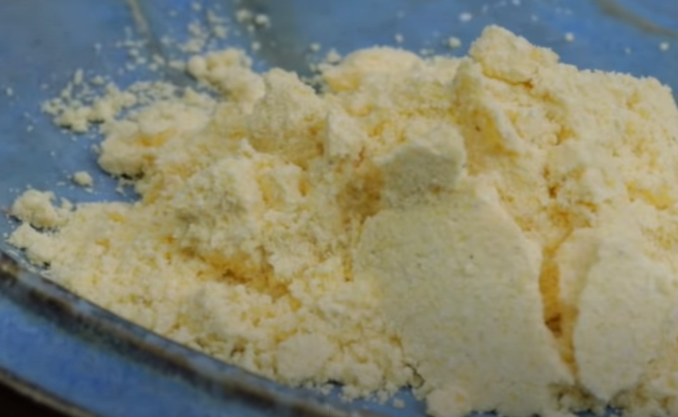
CornFlour

Dal Bhat Tarkari and Side Dishes

A complete dal bhat tarkari or dal bhat sabji set typically includes more than just lentils and rice. Fresh seasonal vegetables (tarkari) are almost always served alongside, making it a well-rounded plate. A full dal bhat set may include:

  • Tarkari (sabji): Sautéed or curried seasonal vegetables — spinach, cauliflower, green beans, or potato
  • Achar: Pickles made from tomato, radish, or mixed vegetables
  • Salads: Fresh cucumber, radish, and carrots
  • Papad (papadum): Thin crispy wafers, commonly served as a crunchy accompaniment
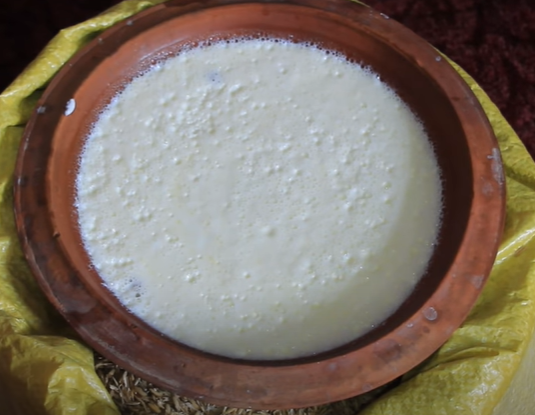
  • Dahi (curd): Plain yogurt that aids digestion
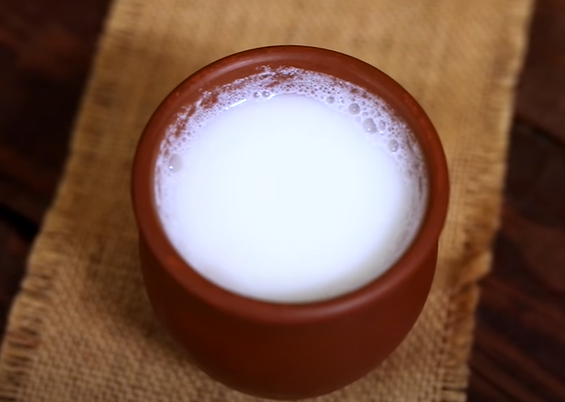
  • Mohi (buttermilk): A cooling, probiotic-rich drink
  • Rice with milk: Sometimes served sweetened with banana, treacle (khudo), or honey

In hilly and mountainous areas — a style often called pahadi dal bhat — rice is frequently substituted with corn grits (atho or chyakhla), buckwheat or millet pudding (dhido), or wheat flatbread (roti). These regional variations reflect Nepal’s geography while preserving the soul of the dish.

Butter Milk
Curd

Dal Bhat Ingredients and Nutritional Value

The simplicity of dal bhat ingredients belies their extraordinary nutritional profile. Together, lentils and rice form a complete meal rich in:

  • Protein: Lentils are the second richest source of plant-based protein after soybeans.
  • Carbohydrates: Rice provides long-lasting energy — the basis of the “24-hour power” claim.
  • Amino acids: Essential for muscle repair and overall health.
  • Vitamin B complex: Supports nervous system function and energy metabolism.
  • Magnesium and Iron: Critical for oxygen transport and bone health.
  • Zinc: Supports immune function.
  • Soluble fiber: Helps lower LDL cholesterol and supports gut health.
  • Folate: Particularly important for women of reproductive age.

Historically, lentils were prized by ancient Egyptian royalty, while paradoxically being considered “poor man’s food” in ancient Greece. Archaeological evidence places lentil domestication as far back as 8000 BC. Today, lentils have been reclaimed as a true superfood — especially vital for vegans and those reducing meat consumption.

Types of Lentils Used in Nepali Dal Bhat

Nepali cuisine uses a wide variety of lentils, each with a distinctive flavor and texture. The most common varieties found in a traditional bhat dal preparation include:

Nepali Name Common Name Notes
Musuro Red lentil Mild, quick-cooking; most common everyday dal
Rahar dal Red gram / Toor dal Slightly earthy; widely used in the Terai
Mas dal Black gram / Urad dal Rich, creamy texture; popular in festive cooking
Moong dal Green gram / Mung bean Light and easy to digest; popular moong dal bhat
Kala bhat dal Black lentil mix A regional favorite; also called kala bhatt dal

Unlike beans, lentils require no overnight soaking and are readily available in dried form at any local market (bazar). Nepali families also prepare Kwati, a nutritious mixed-legume soup made by soaking and boiling nine types of beans, peas, and grams together — often prepared during the festival of Janai Purnima.

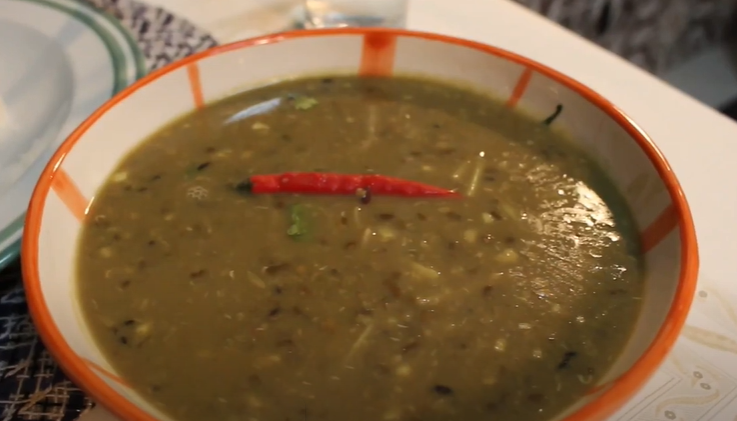
Mas Dal (Black Gram) Lentil Soup
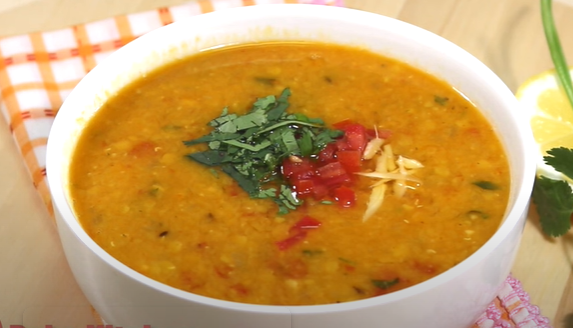
Musuro Lentil Soup

How Dal Bhat Is Cooked: Traditional vs. Modern

Traditionally, bhat food in Nepal was slow-cooked over wood fires. Dal was simmered in brass pots called Kasaudi, infused with whole and ground spices including:

  • Turmeric (besar)
  • Cumin (jeera)
  • Coriander (dhaniya)
  • Fresh ginger (aduwa)
  • Garlic and dried red chili

This slow method extracted deep flavors and was the standard across Nepali kitchens for centuries.

With modernization, most households now use a pressure cooker, which dramatically reduces cooking time while retaining nutritional value. The Kasaudi and the wood-fire hearth (chulo) are becoming rare — a nostalgic memory for older generations, even as the dish itself remains timeless.

Most Nepali people eat dal and rice with their right hand, in keeping with longstanding cultural tradition, rather than using utensils like forks or spoons.

Rice in the Nepali Dal Bhat Set

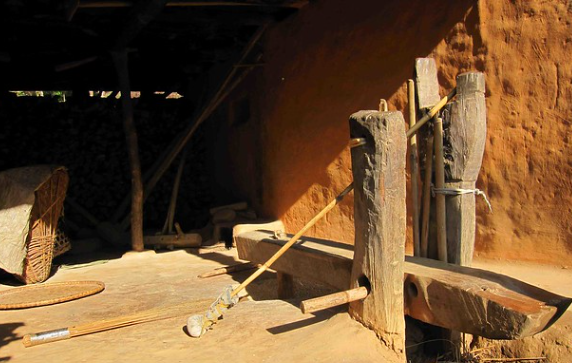
Rice — chawal bhat — is the foundation of the national dish of Nepal. Traditionally, Nepali households consumed brown rice milled using hand-operated rice mills called Dhiki, which could not fully remove the outer bran layer. This meant rice was naturally less refined and richer in fiber.

With modernization, Dhiki mills have nearly disappeared. Fewer families grow their own paddy, and most Nepali people now rely on packaged, polished white rice as their daily staple. While this has changed the nutritional profile slightly, the ritual and cultural significance of dal bhat chawal remains completely unchanged.

Traditional Rice Mill (Dhiki)

Easy Dal Bhat Recipe

This is a straightforward easy dal bhat recipe that captures the authentic flavor of Nepali food dal bhat tarkari at home.

Ingredients (Serves 4)

For the Dal:

  • 1 cup red lentils (musuro) or moong dal, washed
  • 3 cups water
  • 1 tsp turmeric
  • Salt to taste
  • 1 tbsp ghee or mustard oil
  • 1 tsp cumin seeds
  • 2 cloves garlic, minced
  • 1 tsp fresh ginger, grated
  • 1 dried red chili

For the Bhat (Rice):

  • 2 cups white rice, washed
  • 3.5 cups water
  • Pinch of salt

For the Tarkari (Sabji):

  • 2 cups seasonal vegetables (potato, cauliflower, spinach)
  • 1 tbsp oil
  • ½ tsp turmeric, cumin, coriander
  • Salt to taste

Instructions

  1. Cook the dal: Boil lentils with turmeric and salt until soft (about 20 minutes, or 8 minutes in a pressure cooker). In a separate pan, heat ghee, add cumin seeds, garlic, ginger, and dried chili. Pour this tarka (tempering) over the cooked dal and stir.
  2. Cook the rice: Bring salted water to a boil, add washed rice, cover, and simmer on low for 15–18 minutes until fluffy.
  3. Cook the sabji: Sauté vegetables in oil with turmeric, cumin, coriander, and salt until tender.
  4. Serve: Plate rice in the center, pour dal generously over or alongside, add tarkari, achar, and papad as desired.

Pro Tip: For authentic pahadi dal bhat flavor, use mustard oil for tempering and finish the dal with a squeeze of fresh lemon.

In the meantime, you can checkout: Tharu: Their Art, Ornaments, and Tattoos | Aja Dynasty Tharu Cushion Cover: Tharu Tattoo

FAQ

What is the national food of Nepal?

The national food of Nepal is Dal Bhat — steamed rice served with spiced lentil soup. It is eaten daily by people across all regions and ethnicities of the country and is deeply embedded in Nepali cultural identity.

What is dal bhat in English?

Dal bhat translates literally to “lentil rice” in English. Dal (also spelled daal or dhal) refers to lentil soup, while bhat means cooked rice. Together they form Nepal’s most iconic and beloved meal.

What are the main dal bhat ingredients?

The core dal bhat ingredients are lentils, rice, water, turmeric, cumin, coriander, ginger, garlic, and a tempering of oil or ghee. A full dal bhat tarkari set also includes seasonal vegetables, pickles (achar), and sometimes curd or papad.

Is dal bhat healthy?

Yes. Dal bhat food is highly nutritious. Lentils are rich in plant protein, iron, folate, and fiber. Rice provides complex carbohydrates for sustained energy. Together they form a nutritionally complete meal — which is why Nepali people say it powers them for 24 hours.

What is the difference between dal bhat and dal bhat tarkari?

Dal bhat refers to the basic combination of lentil soup and rice. Dal bhat tarkari (or dal bhat sabji) refers to the fuller meal that includes cooked vegetables (tarkari/sabji) as a side dish — which is how it is typically served in Nepali homes and restaurants.

Where can I find dal bhat near me?

If you are searching for dal bhat near me, look for Nepali restaurants, South Asian eateries, or Himalayan cuisine restaurants in your city. Many cities with Nepali diaspora communities have authentic dal bhat set options available.

What is a moong dal bhat recipe?

A moong dal bhat recipe follows the same process as standard dal bhat but uses green gram lentils (moong dal), which are lighter, quicker to cook, and easier to digest. They are especially popular for children and those with sensitive stomachs.

The Chhaya Cushion Cover: How One Piece of Palpali Dhaka Carries Nepal’s Entire Story

There are textiles, and then there are textiles with memory.

Most cushion covers do one job — they cover a cushion. But some carry something more: a lineage, a loom, a community’s identity woven thread by thread into every geometric pattern. The Chhaya Cushion Cover is that second kind of thing. And to understand why, you need to understand Palpali Dhaka — the fabric that made Nepal famous, long before Nepal knew it was famous for it.

Table of Contents


What Is Palpali Dhaka — And Why Does It Matter?

Dhaka is Nepal’s most beloved handwoven fabric. Recognised by its bold geometric patterns, vibrant colours, and dense cotton weave, it has been a fixture of Nepali life for generations — worn as topis, draped as shawls, sewn into daura suruwal, and gifted at every celebration from Dashain to weddings.

The story of Palpali Dhaka begins in the late 1950s, when a weaver named Ganesh Lal Maharjan returned to Palpa having learnt to weave on a handloom in India. On a training visit to Kathmandu, he came across the Dambar Kumari Dhaka fabric — a fine, colourful textile once favoured by Nepal’s royal court. Inspired, he brought the technique back to his hometown and began weaving his own version. By 1967, his fabric had caught on as ‘Palpali Dhaka.’ Inside Himalayas

It was an instant cultural phenomenon. The fabric became a trendsetter of its era — its geometric motifs in red, black, yellow and green made bold statements, and wearing Palpali Dhaka became a status symbol during the reign of King Mahendra, when the Dhaka topi was declared the national cap of Nepal. Palpali

At its peak, the Palpali Dhaka industry provided employment to more than 2,000 weavers, with its distinctive fabric sold in over 36 districts across Nepal. CESLAM Behind each loom was predominantly a woman — weaving not just cloth, but a livelihood, a cultural contribution, a quiet form of defiance against being overlooked.

Today, Palpali Dhaka faces the same pressures that threaten handcraft traditions everywhere: cheaper machine-made fabrics from India and China have flooded the Nepali market, often replicating Dhaka patterns but lacking the cultural integrity and craftsmanship of the original. Wonder Nepal Every authentic piece you choose to bring into your home is a small vote for the real thing.


From the Looms of Palpa to Your Living Room

The Chhaya Cushion Cover is where that centuries-old tradition finds a new home — literally.

Made from Nepali cotton and decorated with authentic Palpali Dhaka fabric, each Chhaya cover carries the full weight of that heritage in a form that fits naturally into modern living. The wooden buttons are handcrafted in Nepal, finishing the piece with the same artisanal commitment that defines the fabric itself. No machine shortcut, no synthetic imitation — just handwork, all the way through.

Interior designers and home decor experts increasingly recommend swapping cushion covers seasonally — using Dhaka in fall and winter for warmth and texture — and sourcing artisan textiles through Nepal-based brands to support fair trade while bringing genuine cultural depth into the home. Expert Sewa The Chhaya range makes that easy to do beautifully.


Choosing Your Size: Small, Medium, or Big?

The Chhaya Cushion Cover comes in three sizes, and the right one depends entirely on your space, your furniture, and how boldly you want the Dhaka patterns to speak

Chhaya Small Cushion Cover — The Accent Piece

The small size is for precision. It works beautifully layered with larger cushions on a sofa, tucked into an armchair, or placed at the corner of a bed where you want a considered cultural detail without overwhelming the space. The Palpali Dhaka patterns are tight and intricate at this scale — the kind of piece guests notice and ask about.

Best for: Armchairs, accent layering, beds, reading corners 👉 Shop the Chhaya Small Cushion Cover →


Chhaya Medium Cushion Cover — The Versatile Everyday

The medium is where most people start, and for good reason. It fits the standard sofa cushion comfortably, works on beds, and is the most versatile size across different furniture styles — from a modern minimalist sofa in Kathmandu to a traditional wooden divan. This is the size that travels most easily between rooms and settings, carrying the Dhaka heritage with it wherever it lands.

Best for: Sofas, beds, floor seating, general home use 👉 Shop the Chhaya Medium Cushion Cover →


Chhaya Big Cushion Cover — The Statement

The big size is for when you want Palpali Dhaka to be seen. At this scale, the geometric patterns have room to fully expand — bold, confident, impossible to miss. It works as a floor cushion, a large sofa statement piece, or layered with smaller Chhaya covers to build a full Dhaka-led living space. If you want your furniture to tell a cultural story without saying a word, the big size does the work.

Best for: Large sofas, floor cushions, statement layering, cultural gifting 👉 Shop the Chhaya Big Cushion Cover →


Why Dhaka Belongs in Your Home — Not Just at Festivals

There is a tendency to treat Dhaka as a ceremonial fabric — something you wear for Dashain, then fold away. The Chhaya Cushion Cover is a quiet argument against that tendency.

Modern Nepali lifestyle decor is embracing a balance between old-world charm and contemporary elegance — using handwoven Dhaka fabrics as cushion covers, throws, and wall hangings to create a bridge between the past and the present, allowing homeowners to personalise their environment with culturally rich aesthetics. Best Art Technology

Putting Palpali Dhaka on your sofa is not nostalgia. It is a design choice — one that happens to support a living craft tradition, keep the looms of Palpa turning, and bring genuine story into a space that might otherwise have only things.

Dhaka is not just for festivals. It never was.


The Wooden Buttons: A Detail That Matters

One small thing worth noting: the wooden buttons on each Chhaya Cushion Cover are handcrafted in Nepal. It would have been easier — and cheaper — to use mass-produced plastic buttons. The choice not to is intentional.

It is the same philosophy that runs through every part of the Chhaya range: the fabric is authentic, the craft is local, the materials are real. When a piece is made this way, you can feel the difference. Not just in texture, but in the sense that what you are holding was made by someone, somewhere, with care.


How to Style the Chhaya Cushion Cover

Dhaka is a strong fabric — it pairs confidently, not timidly. A few styling notes:

Pair with neutrals. White, cream, natural linen, and warm beige let the Dhaka patterns do the work without competition. A neutral sofa with two Chhaya covers is all you need.

Layer sizes. One big, one medium, one small — all Chhaya, all Dhaka — creates a considered, cohesive look that feels intentional rather than matched.

Mix with natural materials. Wood, bamboo, terracotta, brass — the earthy, artisanal quality of Dhaka sits naturally alongside other handmade and natural textures. It does not need to be the only cultural element in the room, but it can hold its own as the centrepiece.

Use it as a gift. A Chhaya Cushion Cover is one of those rare things that is both genuinely useful and genuinely meaningful. For diaspora Nepalis, it is a piece of home. For international friends, it is an introduction to a culture that deserves to be known.


Bring Nepal’s Heritage Home

The Chhaya Cushion Cover is not trying to be a museum piece. It is trying to be part of your everyday life — on your sofa, in your bedroom, in the hands of someone you love when you give it as a gift.

Choose your size. Choose your story.

👉 Chhaya Small Cushion Cover 👉 Chhaya Medium Cushion Cover 👉 Chhaya Big Cushion Cover

Handmade in Nepal. Authentic Palpali Dhaka. Wooden buttons handcrafted in Nepal. Each piece is unique.

Newsletter

Letters from Kathmandu.

A quiet note once a month — new arrivals, artisan stories, and small invitations. No noise. Unsubscribe any time.